

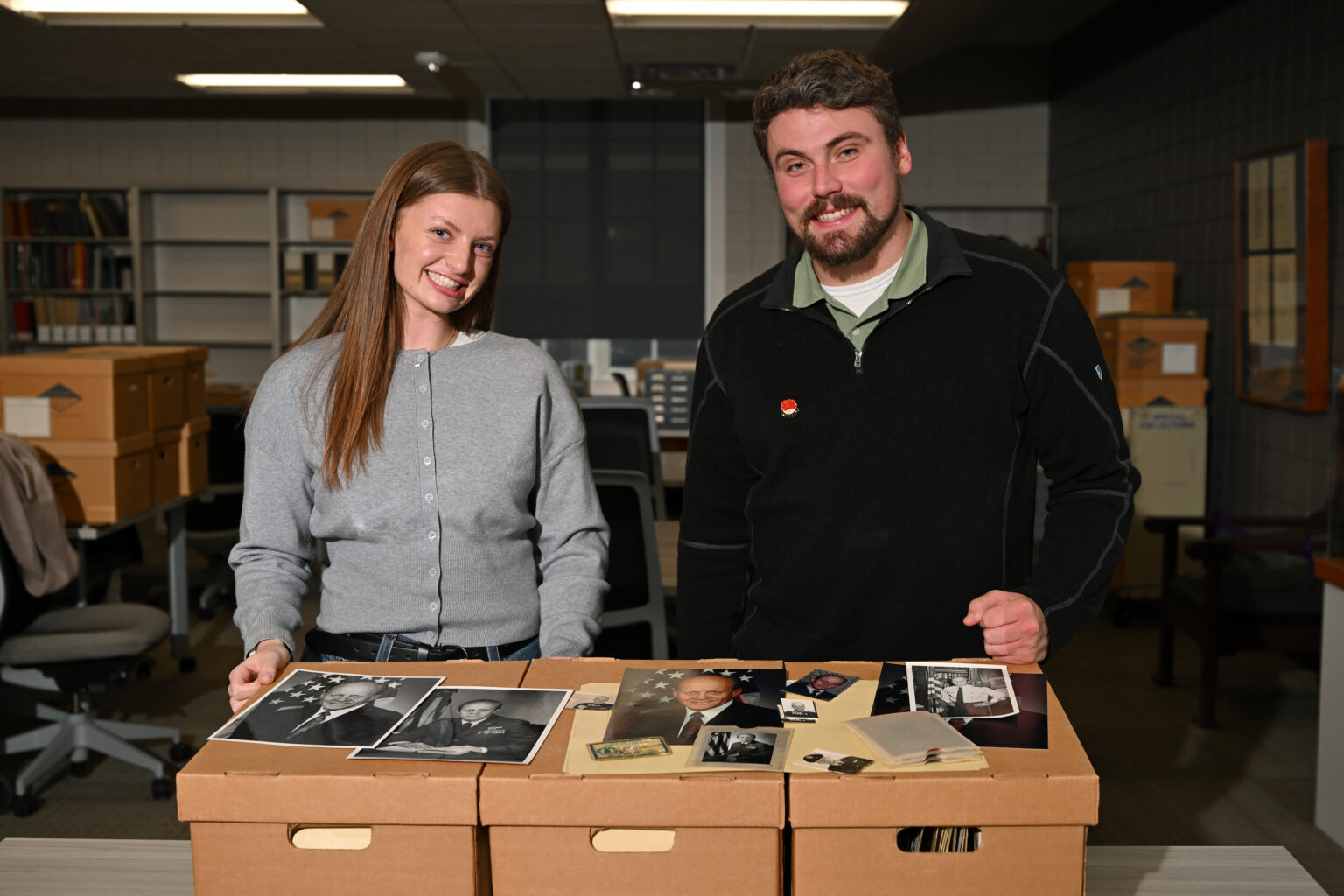
University of North Dakota students Bella Hammer and Trevor Taylor pose with historical documents at the University of North Dakota’s Chester Fritz Library on Nov. 10, 2026. The students have been working to digitize records related to U.S. service members missing from the Korean and Vietnam wars. (Photo by Russell Hons/For the North Dakota Monitor)
GRAND FORKS, ND (North Dakota Monitor) – Bella Hammer, a social work student and member of the North Dakota Air National Guard, regularly supports military-affiliated students as part of her work with the University of North Dakota’s Veteran & Military Services.
She recently found a new way to serve veterans when she played a role in an archival project.
Hammer is one of two UND students who digitized records that could help investigators search for missing U.S. service members and civilians in southeast Asia. She helped to scan 6,400 pages from the James Wold Papers, which are preserved in UND’s Chester Fritz Library.
“It was such a rewarding and unique opportunity,” she said. “I’m so honored to have been asked.”
The records were requested by Tours of Duty, a nonprofit that works with veterans and families seeking answers about their missing loved ones. As part of its work, the organization collects information that could shed light on the past.
“In our world, data is gold,” said Mike Luehring, who works with Tours of Duty. “When I heard about the Wold Papers, I realized this is something that would be valuable to our pursuit. When you’re trying to help families, you cast as big of a net as possible.”
The Wold Papers date from 1943 to 2003, the year Wold died, and have been housed at UND since 2007.
Wold enlisted in the U.S. Air Force in 1951 and commanded units in Vietnam. He retired from the Air Force in 1977 and went on to earn his degree at the University of North Dakota School of Law. He established a law practice in Luverne, North Dakota.
In 1994, Wold was appointed as the deputy assistant secretary of defense for POW/MIA Affairs. His work included efforts to account for Americans missing from the Korean and Vietnam wars.
Some of his records contain detailed information about service members whose remains were never recovered, according to Curt Hanson, who works with special collections at the Chester Fritz Library.
“The collection is all the documents he had from that time,” Hanson said. “It’s unlike any other collection we have.”
When Luehring contacted the archives to receive copies of some of the papers, Hanson knew it would take more time to scan than he and other staff members could commit to the project.
That’s how Hammer and Trevor Taylor got involved.
Like Hammer, Taylor works in the UND Veteran & Military Services as peer support for other military-affiliated students. He served as a combat medic in the U.S. Army from 2021-25. After completing his tour, he came to UND to study commercial aviation.
When he was asked if he would help scan documents from the Wold collection. Taylor didn’t hesitate. For him, it was an opportunity to honor those who served before him and to play a small role in bringing a forgotten generation of veterans back home.
“I served during the post-War on Terror when we had community support. This Vietnam generation didn’t have that,” Taylor said. “We left a lot of people behind, and a lot of people wanted to clean their hands of the conflict.”
More than 80,000 service personnel are missing from previous conflicts, according to the U.S. Department of Defense. About 38,000 are estimated to be recoverable.
It’s uncertain whether the Wold Papers will lead directly to any new discoveries, Luehring said. When trying to reconstruct events that occurred decades ago, any detail can become a needed piece of a much larger puzzle. Tours of Duty uses artificial intelligence tools to find connections, but investigators still conduct in-person interviews and study archival records to generate leads.
Luehring said he is grateful that UND students have been part of this project. Tours of Duty wants younger veterans to become involved in efforts to account for those who served before them.
“We emphasize this idea that no person can be left behind,” Luehring said. “When we have young veterans and service members participating in our work, we know they’re experiencing that message.”
For Hammer and Taylor, this has meant spending hours at a scanner.
Taylor spent most of his volunteer hours scanning Wold’s personal journals and correspondence between the general and Vietnam military officials in the ’90s.
While doing so, Taylor couldn’t help but speculate.
“I imagine Gen. Wold talking to his former enemies in a combined effort to bring home our fallen service members,” Taylor said. “They deserve respect no matter what side they were on.”
Hammer scanned more professional documents. She saw maps of different areas and invitations from dignitaries.
As she did the work, she considered all the people and volunteers working toward a common purpose.
“I kept thinking about all the families we might be able to help,” she said. “If we can give even one family closure, that is important. I’m glad to do my part.”






Comments